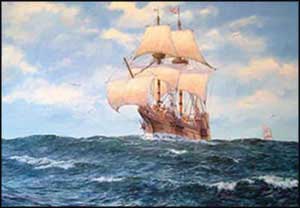
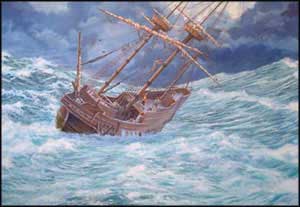
Stephen
Hopkins of the Mayflower
By: Kate L. McCarter
(Reprinted
with permission.
McCarter
Family Web Site
)
Stephen
Hopkins was born during the reign of
Queen Elizabeth I and came of age as
England was experiencing great
economic growth, increased overseas
exploration, and a renaissance in
the arts. Stephen was among the new
class of Englishmen who left the
countryside for London to become
merchants, seamen, or settlers in
the New World, but his adventuresome
nature would eventually put him in a
class by himself.
He was one of
the first in Bermuda, where he
survived shipwreck, mutiny, and near
execution earning satirization in
William Shakespeare's play The
Tempest. He was one of the
first in Jamestowne, the
earliest permanent European
settlement in North America, where
he faced starvation, disease, and
Indian attack. And sailing on the
Mayflower, he was one of
the first in New England, where he
used his previous New World
experience to shape the history of
Plymouth Plantation.
In Hopkins
of the Mayflower, Margaret
Hodges writes, "Adventurers like
Stephen broke the chains that bound
Englishmen to a fixed and
unalterable state of life in a fixed
and unalterable society. In their
ships they carried . . . ideas,
planting the seeds of economic,
social, and ethical thought that are
with us yet."
Growing Up
in Elizabethan England
|
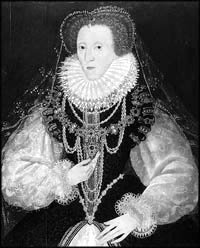
Queen Elizabeth I
Reigned
England from 1558-1603
|
Although
Stephen Hopkins is a fairly well
known figure in American history,
much that has been written about his
origins is incorrect. For years his
biographers claimed that he had been
born in Wortley, Wooton-under-Edge
and had married Constance Dudley.
Recent research by historian Caleb
Johnson (1998) shows that
Stephen was actually from Hursley,
Hampshire and married to a woman by
the name of Mary.
Stephen was
probably born about 1579 in
Hampshire. His parents may have been
John and Elizabeth Hopkins of
Winchester, Hampshire whose son,
William, had a wife named Constance.
Constance was an unusual name in
Hampshire, so when Stephen gave this
name to his second daughter, it may
have been because of a family
connection.
Items
enumerated in a church
inventory,
after the untimely death of his
wife, suggest that Stephen may have
been a shop or tavern keeper.
Shipwrecking
in Bermuda
In
1603 Queen Elizabeth I was succeeded
by King James I, who chartered the
Virginia Company of London to
establish a colony in North America.
The company was a consortium of
businessmen whose objectives were to
find gold and silver and a route to
the Indies. To man the venture, the
Virginia Company recruited everyone
from gentlemen dreamers to prisoners
who would gain their freedom after
serving a term of indenture. Many
recruits were veterans of the
Spanish wars who had been beggared
by the peace.
|
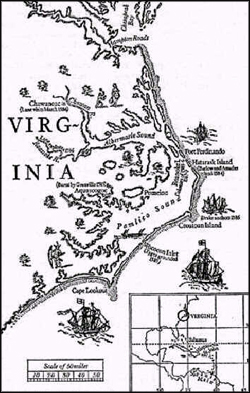
Jamestown Colony |
Shakespeare's
character Falstaff describes the
would-be colonists as "ancients
[ensigns], corporals, lieutenants,
gentlemen of companies, slaves as
ragged as Lazarus in the painted
clothes . . . and such as, indeed,
were never soldiers, but discarded
unjust serving-men, younger sons to
younger brothers, revolted tapsters
[such as Stephen] and ostlers trade
fallen, the cankers of a calm world
and a long peace."
On May 14,
1607, the Virginia Company deposited
about 100 men 35 miles inland on the
James River in Virginia. They
immediately set about making a
colony at Jamestowne, but
faced continual disappointment as
mere survival became their primary
aim.
They had the
sheer misfortune of having arrived
during the worst drought in 700
years, so growing crops was out of
the question and safe drinking water
was in short supply. The climate was
hot and humid, and their fort sat in
the midst of a malarial
mosquito-infested swamp. The colony
had been situated inland to avoid
Spanish warships, but faced a
greater threat from the native
Algonquians headed by the powerful
chief Powhatan.
Also called
Wahunsonacock, Powhatan was the
leader of a large confederation of
tribes that lived on the East Coast
from Spanish Florida to the Potomac
River. Powhatan's father had been
driven north from Florida by the
Spanish, so he had consolidated his
tribe with six others. Powhatan
expanded this confederacy until it
consisted of about ten thousand
people in thirty different tribes.
The Algonquians opposed the English
colonists and hostilities broke out
on both sides with little
provocation.
In all, the
toll taken by disease, malnutrition,
and violent death was appalling, and
Jamestown was nearly wiped out in
the first seven months. "Our men
were destroyed with cruel disease
as Swellings, Flixes, Burning
Fevers, and by warres," wrote
colonist George Percy. "Some
departed suddenly, but for the most
part they died of meere famine." The
colony was saved from extinction by
Captain John Smith who brought more
men and supplies in 1608.
|
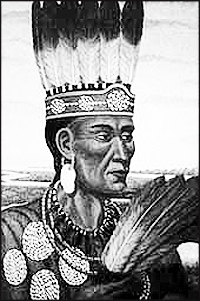
Chief Powhatan |
A year
later, Stephen left his wife and
three small children in Hursley to
sign on with the Third Supply, a
fleet of nine ships taking 500
settlers and a mountain of supplies
to Jamestown. Having no money to
invest, and no rank of any kind,
Stephen's name does not appear on
the list of Virginia Company
investors. Instead, he is lumped
with the anonymous "sailors,
soldiers, and servants" on the
fleet's flagship, the Sea
Venture. He is later described
by William Strachey, who chronicled
the voyage of the Sea Venture,
as "A fellow who had much knowledge
in the Scriptures, and could reason
well therein" and therefore was
chosen by Chaplain Richard Buck "to
be his Clarke, to read the Psalms,
and chapters upon Sondayes at
assembly of the Congregation under
him."
In a
typical contract with the Virginia
Company, Stephen would serve three
years as an indentured servant, his
labors profiting those who had
financed the venture. In exchange,
he would receive free
transportation, food, lodging, and
10 shillings every three months for
his family back home. At the end of
three years, he would be freed from
his indenture and given 30 acres in
the colony.
On May 15,
1609, the Sea Venture,
under the command of Sir George
Somers, sailed down the Thames
followed by the rest of the Virginia
Company's fleet – the Falcon,
Diamond, Swallow,
Unity, Blessing,
Lion, and two smaller
crafts.
Hodges
writes, "For seven weeks the ships
stayed within sight of each other,
often within earshot, and captains
called to one another by way of
trumpets. On the Sea Venture
all was peaceful. Morning and
evening, Chaplain Buck and Clerk
Hopkins gathered the passengers and
crew on deck for prayers and the
singing of a psalm."
The ships
were only eight days from the coast
of Virginia, when they were suddenly
caught in a hurricane, and the
Sea Venture became separated
from the rest of the fleet. William
Strachey chronicled the Sea
Venture's final days.
On St. James
Day, being Monday, the clouds
gathering thick upon us and the wind
singing and whistling most
unusually, a dreadful storm and
hideous began to blow from out the
northeast, which, swelling and
roaring as it were by fits, at
length did beat all night from
Heaven; which like a hell of
darkness, turned black upon us . . .
For four-and-twenty hours the storm
in a restless tumult had blown so
exceedingly as we could not
apprehend in our imaginations any
possibility of greater violence; yet
did we still find it not only more
terrible but more constant, fury
added to fury, and one storm urging
a second more outrageous than the
former . . .
The next
day was worse. "It could not be said
to rain," wrote Strachey. "The
waters like whole rivers did flood
in the air. Winds and seas were as
mad as fury and rage could make
them. Howbeit this was not all. It
pleased God to bring greater
affliction yet upon us; for in the
beginning of the storm we had
received likewise a mighty leak."
The ship
had begun to take on water and every
man who could be spared went below
to plug the leaks and work the
pumps. The men worked in waist-deep
water for four days and nights, but
by Friday morning they were
exhausted and gave up.
Another chronicler, Silvester
Jourdain, wrote that some of the
men, "having some good and
comfortable waters [gin and brandy]
in the ship, fetched them and drunk
one to the other, taking their last
leave one of the other until their
more joyful and happy meeting in a
more blessed world." Then there was
a crash and the Sea Venture
began to split seam by seam as the
water rushed in.
Jourdain continues,
|

Wreck of the Sea Venture |
And there
neither did our ship sink but, more
fortunately in so great a
misfortune, fell in between two
rocks, where she was fast lodged and
locked for further budging; whereby
we gained not only sufficient time,
with the present help of our boat
and skiff, safely to set and convey
our men ashore . . .
The Sea
Venture had been thrown upon a
reef about a mile from Bermuda, then
known as the "Isle of the
Devils." Those who could swim
lowered themselves into the waves
and grasped wooden boxes, debris, or
anything that would keep their heads
above water. Stephen made it to
shore clutching a barrel of wine.
The entire crew, including the
ship's dog, survived.
As it turned out, the Sea
Venture did not break apart and
the men were able to retrieve the
tools, food, clothing, muskets, and
everything that meant their
survival. Most of the ship's
structure also remained, so using
the wreckage and native cedar trees,
the 150 castaways immediately set
about building two new boats so that
they could complete their voyage to
Jamestown.
The men
were pleasantly surprised to find
that the island's climate was
agreeable, food plentiful, and
shelters easily constructed from
cedar wood and palm leaves. The
Isle of the Devils, turned out
to be paradise, and a few began to
wonder why they should leave.
Strachey recounts that some of the
sailors, who had been to Jamestown
with the Second Supply, stated that
"in Virginia nothing but
wretchedness and labor must be
expected, there being neither fish,
flesh, or fowl which here at ease
and pleasure might be enjoyed."
The first
attempt at mutiny was made by
Nicholas Bennit who "made much
profession of Scripture" and was
described by Strachey as a "mutinous
and dissembling Imposter." Bennit
and five other men escaped into the
woods, but were captured and
banished to one of the distant
islands. The banished men soon found
that life on the solitary island was
not altogether desirable and humbly
petitioned for a pardon, which they
received. But the clemency of the
Governor only encouraged the spirit
of mutiny. William Strachey notes
that while Hopkins was very
religious, he was contentious and
defiant of authority and had enough
learning to wrest leadership from
others. On January 24, while on a
break with Samuel Sharpe and Humfrey
Reede, Stephen argued,
. . . it was
no breach of honesty, conscience,
nor Religion to decline from the
obedience of the Governor or refuse
to go any further led by his
authority (except it so pleased
themselves) since the authority
ceased when the wracke was
committed, and, with it, they were
all then freed from the government
of any man . . .[there] were two
apparent reasons to stay them even
in this place; first, abundance of
God's providence of all manner of
good food; next, some hope in
reasonable time, when they might
grow weary of the place, to build a
small Barke, with the skill and help
of the aforesaid Nicholas Bennit,
whom they insinuated to them to be
of the conspiracy, that so might get
clear from hence at their own
pleasures . . . when in Virginia,
the first would be assuredly
wanting, and they might well fear
to be detained in that Countrie by
the authority of the Commander
thereof, and their whole life to
serve the turnes of the Adventurers
with their travailes and labors.
The mutiny
was brought to a quick end when
Sharpe and Reede reported Stephen to
Sir Thomas Gates who immediately put
him under guard. That evening, at
the tolling of a bell, the entire
company assembled and witnessed
Stephen's trial.
. . . the
Prisoner was brought forth in
manacles, and both accused, and
suffered to make at large, to every
particular, his answere; which was
onely full of sorrow and teares,
pleading simplicity, and deniall.
But he being onely found, at this
time, both the, Captaine and the
follower of this Mutinie, and
generally held worthy to satisfie
the punishment of his offence, with
the sacrifice of his life, our
Governour passed the sentence of a
Maritiall Court upon him, such as
belongs to Mutinie and Rebellion.
But so penitent hee was, and made so
much moane, alleadging the ruine of
his Wife and Children in this his
trespasse, as it wrought in the
hearts of all the better sorts of
the Company, who therefore with
humble entreaties, and earnest
supplications, went unto our
Governor, whom they besought (as
likewise did Captaine Newport, and
my selfe) and never left him untill
we had got his pardon.
After
pleading his way out of a hanging,
Stephen continued his duties as
Minister's Clerk and worked quietly
with the others to finish the
construction of the ships. On May
10, 1610, the men boarded the newly
built Deliverance and
Patience and set out for
Virginia. They arrived in Jamestown
on May 24, almost a full year after
they had left England.
Surviving
Jamestown
|
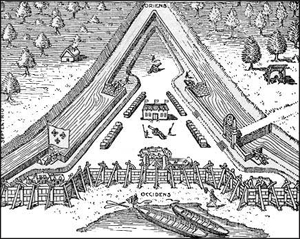
James Fort |
What the
Sea Venture's crew found
when they reached Jamestown
undoubtedly made them grateful to
have been shipwrecked.
Over the
winter, food had become so scarce
that the settlers had been compelled
to eat their horses, dogs, and even
the flesh of those who had died.
Only 50 of the 500 colonists
remained. In contrast, the Bermuda
crew were well-fed and healthy.
Strachey
wrote of Jamestown, "the palisades
torn down, the ports open, the gates
off the hinges, and empty houses
rent up and burnt, rather than the
dwellers would step into the woods a
stone's cast off to fetch other
firewood. The Indians killed as
fast, if our men but stirred beyond
the bounds of their blockhouse, as
famine and pestilence did."
The new
arrivals calculated that the meal
cakes they had brought with them
would feed everyone for no longer
than ten days. So it appeared that
abandonment of the settlement was
their only hope. The plan was for
all to board the Patience
and Deliverance and sail up
the coast to Newfoundland where, at
this time of year, they could find
fishing vessels to take them home to
England. They anchored that night
off an island near the mouth of the
James. The next morning they were
surprised by an approaching longboat
which brought the news that Lord
Delaware was following with three
shiploads of settlers and provisions
to feed 400 for a year. The settlers
from Jamestown returned to the
abandoned colony and were at the
gate of the fort to welcome the new
governor when he dropped anchor on
June 10th.
Delaware
immediately set about restoring the
broken down fort. By midsummer the
gate and palisade were repaired, and
there was a new chapel and three
rows of houses inside the triangular
fort. Jamestown finally seemed to be
on solid footing.
|
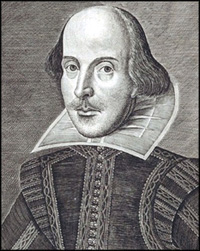
William Shakespeare |
In the
meantime, Strachey's account of the
wreck of the Sea Venture
had made it back to England.
Strachey was no stranger to the
theater people who met regularly at
the Mermaid Tavern, so it's probable
that Shakespeare was among those who
got a preview of the work. Some
believe he used it as the basis for
his farewell play, The Tempest,
which relates the story of a
shipwrecked group stranded on an
enchanted island. In a play to be
performed for the King, a rebel
could only be shown as a clown or a
villain, so Shakespeare created a
drunken, mutinous butler (or
bottler) with delusions of grandeur
who he named Stephano.
Hodges
writes, "To have provided some of
the fabric for Shakespeare's vision
of The Tempest and to
appear in the play, even in the
absurd disguise as Stephano, this in
itself is a kind of immortality for
Stephen Hopkins."
Several
years later, the Virginia Company
published a heavily sanitized
version of Strachey's A True
Reportory fearing that if the
public knew the truth about
Jamestown, there would be no more
recruits.
Stephen
does not appear on any of the lists
of Jamestown colonists and, after
his attempted mutiny, the assumption
is that he was put on the first ship
back to England. However, he is not
in England in 1613 when his wife
dies, and his later familiarity with
Indians in Plymouth suggests that he
may have spent several years in
Jamestown.
|
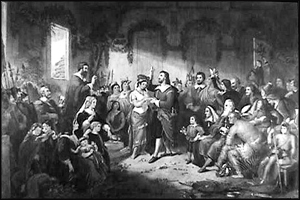
Pocahontas Marries John Rolfe |
During
these years (1610-14), survival
remained the primary aim of the
Jamestown colonists. The climate was
unhealthy for Englishmen who were
used to northern latitudes, and the
settlers were constantly afflicted
with "fluxes and agues." The Indians
also posed a continual threat until
April 5, 1614 when John Rolfe
married Pocahontas, the daughter of
Chief Powhatan. If Stephen had
managed to get back into the good
graces of the Jamestown authorities,
it's not unreasonable to assume that
he may have assisted Master Buck in
performing the wedding ceremony.
Returning to
England
In the
spring of 1613, Stephen's wife,
Mary, died. She may have been a
victim of the plague which was still
rampant in certain parts of England.
With Stephen absent and presumed
dead, the Church liquidated the
couple's estate to provide for the
children.
An
inventory of the goods and
Chattells of Mary Hopkins of
Hursley in the Countie of
South[amp]ton widowe deceased
taken the tenth day of May 1613
as followeth vizt.
Inprimis
certen Beames in the garden &
wood in the back side
It[e]m the ymplem[en]ts in the
Beehouse
It[e]m certen things in the
kitchin
It[e]m in the hall one table,
one Cupboorde & certen other
things
It[e]m in the buttry six small
vessells & some other small
things
It[e]m brasse and pewter
It[e]m in the Chamber over the
shop two beds one table & a
forme with some other small
things
It[e]m in the Chamber over the
hall one fetherbed & 3 Chests &
one box
It[e]m Lynnen & wearing
apparrell
It[e]m in the shop one
shopboarde & a plank
It[e]m the Lease of the house
wherin she Late dwelled
It[e]m in ready mony & debts by
specialitie & without
specialitie
S[um] total xxv xj [25 pounds 11
shillings]
Gregory
Horwood (his X mark)
William Toot
Rychard Wolle
Stephen
returned home sometime between
1613-17, perhaps with the intent of
selling his belongings in England
and bringing his family to their new
home in Virginia. After having
survived shipwreck and the perils of
Jamestown, it must have been a great
blow to find his wife and estate
gone, and his children entrusted to
the care of the Church.
By late
1617 Stephen and his children had
settled into a home just outside of
the east wall of London, where he
was said to be working as a tanner.
On February 9, 1618, in the local
church of St. Mary Matfellon in
Whitechapel, he married his second
wife, Elizabeth Fisher. In late 1618
Elizabeth and Stephen added another
child to the family – a daughter
they named Damaris.
|
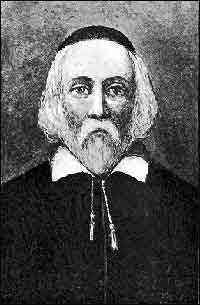
William Brewster |
Nearby the
Hopkins' home was the infamous
Henage House – a mansion that had
been converted into apartments which
housed a number of nonconformists.
Among these were Robert Cushman,
John Carver, and William Brewster,
members of the Scrooby Separatist
congregation who had fled to Leyden,
Holland years earlier to escape
religious persecution. The three had
returned to raise money for a patent
to create a settlement in the New
World for their congregation now
living in exile in Holland
The
dissenters movement had begun about
40 years earlier when Cambridge
scholar Robert Browne began
preaching sermons denouncing the
Church of England as "a huge mass of
old and stinking works," and
accusing its members of "conjuring,
witchcraft, sorcery, blasphemy,
murder, manslaughter, robberies,
adultery, fornication, and lieing."
Because church attendance was
mandatory for all English citizens,
Browne's remarks, while somewhat
hyperbolic, may not have been too
far off the mark.
The
dissenters were true-believers who
generally fell into either the
Separatist or Puritan camps. In
general, the Separatists' views were
not as extreme as the Puritans' in
regard to social customs. They
dressed in the bright colored
clothing of the period, drank
alcohol, attended plays, and danced.
They were, however, more extreme
when it came to separating ties with
the Church of England. The Puritans
believed that the established church
could be reformed. The Separatists
held that membership in the Church
of England violated the biblical
precepts for true Christians, and
that they had to break away and form
independent congregations. At a time
when Church and State were one, such
beliefs were treasonous.
|
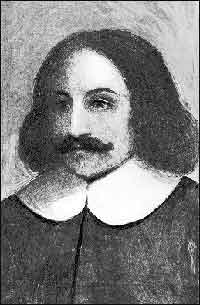
William Bradford |
William
Bradford, an orphan boy adopted by
the Brewsters and eventual governor
of the Plymouth Colony, tells of the
abuse suffered by the Scrooby
Separatist congregation before they
fled to Leyden. "They were hunted
and persecuted on every side. Some
were taken and clapped up in prison,
others had their houses beset and
watched day and night, and most were
fain to flee and leave their houses
and habitations, and the means of
their livelihood." In the end the
little group did abandon their
homeland for Holland, where
religious tolerance was the rule.
In Leyden,
the Scrooby Separatists found no
barriers to practicing their faith.
However, as foreigners, they were at
the bottom of the economic ladder
and had to put their children to
work simply to survive. They feared
the negative influence of the Dutch
on their children, and the loss of
their English traditions. They also
worried about the threat of renewed
war between the Dutch and the
Spanish, which could bring the loss
of their religious freedom.
So in the summer of 1618 the little
congregation made the decision to
emigrate yet again. John Carver,
Robert Cushman, and William Brewster
were sent to London to try to get
financial backing for a Separatist
settlement in America.
To settle in the New World required
a patent (license to colonize) and
backing by investors. The
Separatists rejected an offer to
settle under the auspices of the
Dutch Government in New Amsterdam
and instead approached King James
who refused to give them an official
patent, but said that if they went
to Jamestown he "would not molest
them, provided they carried
themselves peaceably." The
Separatists feared that they would
be persecuted if they joined the
English colony in Virginia, so
rejected this offer too.
Finally
Thomas Weston, a London merchant,
offered a proposal. He had heard
that the Plymouth branch of the
Virginia Company had asked for a
patent to settle "Northern Virginia"
at the mouth of the Hudson River.
This seemed like a good location for
the Separatists because it was far
away from Jamestown and the
established Church, and was near the
more tolerant Dutch settlements.
A group of
English investors known as "merchant
adventurers" agreed to finance the
voyage and settlement. They formed a
joint-stock company with the
colonists in which they would
"adventure" or risk their money in
exchange for the settlers' personal
labor for a period of seven years.
During that time, all land and
livestock were to be owned in
partnership. At the end of seven
years, the company would be
dissolved and the assets divided.
Weston
found seventy investors, but in the
end only a small number of
Separatists were willing to risk
their lives making a dangerous
voyage to an unknown land. Weston
solved the problem by recruiting
others who were sympathetic to the
Separatist cause, but were primarily
interested in relocating in the New
World for economic reasons. One of
those he approached was his
neighbor, Stephen Hopkins. With his
previous New World experience,
Stephen knew much that would be of
use to the future colonists. He
agreed to the new venture, but this
time would not be leaving his family
behind.
The voyage
was set for early spring so that the
colonists would arrive in the New
World in time to prepare for winter.
But there were many delays and the
spring of 1620 came and went, and it
was July before the Separatists left
Leyden in their small ship, the
Speedwell. They sailed to
Southampton, a city on the English
south coast, where they were joined
by the investors and the
non-Separatists recruited by Weston.
For their primary transportation,
the investors had hired the
Mayflower, a larger ship that
had been used in the wine trade.
|

Pilgrims Set Sail for the New
World |
The
Separatists hoped to fulfill their
contract with the investors by
becoming fishermen, but some of the
more experienced men, such as
Stephen, realized the group was
ill-prepared. They had purchased
fish hooks that were too large and
nets that were too weak, and brought
almost nothing to trade with the
Indians. When Robert Cushman arrived
at Southampton, he was advised to
buy more muskets and armor, as well
as copper chains, beads, knives,
scissors, and other things to trade
with the natives.
Disagreement over the contract
brought another delay. The original
plan called for the colonists to
work five days a week for seven
years to pay their debt. In the end
they would own their houses and a
share of the land worth 10 pounds.
After five weeks of pressure from
the investors, Cushman signed a new
agreement in which the colonists
would work seven days a week for
seven years to pay their debt and
would own nothing privately, not
even the roofs over their heads.
Under the new agreement they would
risk their lives and work like
slaves for seven years with nothing
to show for it but their share of
land. They also learned that Weston
had no clear patent from the
Virginia Company and had not even
invested his own money in the
enterprise.
There had
never been a more poorly planned and
supplied venture, but the settlers
were willing to forge ahead. On
August 5, 1620, they boarded the two
ships and set sail for the New
World.
Their
voyage was soon interrupted,
however, when the smaller
Speedwell began leaking. They
put into the port at Dartmouth and
made repairs, but the condition
recurred once they were under sail
again. They managed to make it to
port in neighboring Plymouth where
they decided to abandon the
unreliable ship. The already crowded
Mayflower could take on
only a few of the Speedwell's
passengers, so the rest had to
return to Leyden. Only 35 of the
Separatists remained. The other 67
Mayflower passengers were
the non-Separatist Londoners who had
been recruited by Weston. On
September 6, 1620, these Pilgrims
(Separatists and non-Separatists
alike) set sail across the North
Atlantic headed for the northernmost
boundary of the Virginia colony.
Sailing on the
Mayflower
The
Hopkins family was one of the
largest aboard with Stephen, his
wife Elizabeth, the children
Constance, Giles, and Damaris,
and their two servants Edward
Doty and Edward Leister. The
family grew even larger when
Elizabeth gave birth to their
son, Oceanus, while they were
still at sea. The fate of
Stephen's oldest child,
Elizabeth, is unknown. She may
have died or, being of age, may
have decided to stay in England.
The
pilgrims spent most of the voyage in
the dark quarters on the gun deck.
One side of the deck was taken up by
a shallop (boat) which was essential
for landing and exploring. On the
other side, they nailed up
compartments for the women and
children of each family. The men
slept wherever they could hang a
hammock. Many ended up in the
shallop. They occasionally went up
for air on the upper deck, but the
Mayflower's longboat filled
most of the space and the crew was
often unfriendly.
At the end
of September, the Mayflower
was caught in an equinoxial storm.
The pilgrims mattresses and clothes
were soaked, and they were chilled
to the bone. Their cooking fires
were doused, so they had to make do
with dried beef, biscuits, and
cheese for the rest of the voyage.
They were
about halfway across the ocean when
fierce crosswinds cracked one of the
main beams leading to severe leaks
in the upper works. The passengers
from Leyden saved the day by
bringing forth a great jackscrew
meant for raising houses. They used
it to force the Mayflower's
beam back into place and make the
ship sound again. The storms finally
eased, and the Mayflower's
sails were raised to a favoring
wind.
When the
Mayflower sighted land on
November 9, 1620, first mate John
Clark recognized the shoreline of
Cape Cod, which was north of their
original destination of the mouth of
the Hudson River. The crew changed
course, but after encountering some
dangerous shoals and nearly
shipwrecking at Monomoy Point, they
returned to the Cape.
On November
11, after 66 days at sea, the
Mayflower came to anchor in
what is now Provincetown harbor, and
Stephen once again found himself on
a ship which had reached an
unintended destination.
Some of the
settlers wanted to continue the
search for the mouth of the Hudson.
Others argued for remaining in the
Cape where they would be free to do
as they pleased. Stephen, despite
his near execution for treason in
Bermuda, was among the latter.
Governor
William Bradford in Of Plymouth
Plantation wrote of the
difficulty, "ye discontented &
mutinous speeches that some of the
strangers [non-Separatists] amongst
them had let fall from them in ye
ship – That when they came a shore
they would use their own libertie;
for none had power to command them,
the patente they had being for
Virginia and not for New England
which belonged to an other
government, with which the ye
Virginia Company had nothing to doe.
And partly that shuch an acte by
them done (this their condition
considered) might be as firme as any
patent, and in some respects more
sure."
The issue
was finally resolved by Captain
Jones who brought the Mayflower
into a harbor off the northwest
shore of Cape Cod and let the anchor
go. Unwilling to risk the
Mayflower in a midwinter search
for the Hudson, he suggested they
settle where they were.
|

Signing of the Mayflower Compact |
The
forty-one adult male passengers
gathered in the cabin of the
Mayflower to decide what to do
next. With the help of William
Brewster's book of law, they
formulated and signed the
Mayflower Compact which
consolidated the passengers into a
"body politic" that had the power to
enact laws for the settlement. The
compact also established the rule of
the majority, which remained a
primary principle of government in
Plymouth Colony until it became part
of the Massachusetts Bay Colony in
1691.
Then the
longboat was launched, and sixteen
men equipped with muskets, swords,
and corselets went ashore under
Captain Miles Standish "unto whom
was adjoined, for counsel and
advice, William Bradford, Stephen
Hopkins, and Edward Tilley," wrote
Bradford.
Stephen was
one of only three who had been to
the New World before. Now in his
forties, he was one of the seniors
of the expedition, both in age and
experience, so it is not surprising
that he would become one of
Standish's chief aides.
Bradford
continues, "Being thus arrived in a
good harbor, and brought safe to
land, they fell upon their knees and
blessed the God of Heaven who had
brought them over the vast and
furious ocean, and delivered them
from all the perils and miseries
thereof, again to set their feet on
the firm and stable earth, their
proper element."
Founding
Plymouth Plantation
The
Mayflower remained anchored in the
harbor as the passengers were taken
ashore to walk off the months of
travel, bathe, and wash their
clothing and linens. As some of the
colonists assembled the shallop,
Captain Standish and his sixteen
armed men continued to explore the
immediate area to find a
satisfactory site for the colony.
They saw
some Indians from afar, but were
unable to catch up with them. They
found the remains of a fortification
and discovered a buried cache of
corn which they took. Mourt's
Relation, an account of the
pilgrim's first year in Plymouth,
tells how the group "came to a tree
where a young spirit [sapling] was
bowen down over a bow, and some
acorns strewed underneath, Stephen
Hopkins said it had been to catch
some deer." While he was explaining
how it worked, William Bradford came
from the rear to look. "As he went
about, it gave a sudden jerk up, and
he was immediately caught by the
leg."
|

Pilgrim's Landing |
After the
shallop was assembled, 34 men joined
the second expedition which explored
further along the inner Cape. They
found many signs of the native
population which had fled at their
approach. They also found more corn
and the burial site of a European
man.
While the
men explored the coastline, the
women were left on board the
Mayflower to worry about the
fate of their husbands, and contend
with spreading sickness brought on
by dampness, cold, and malnutrition.
The colonists had to settle
somewhere soon.
One of the
ship's crew knew of a good inlet
further along the coast that the
sailors called "Thievish Harbor." On
December 6, Stephen was one of ten
men that braved the frigid weather
to take the shallop along the coast.
They found an Indian burial ground
and some unoccupied dwellings before
camping for the night. At daybreak
they were attacked by members of the
Nauset tribe. There was a brief
exchange of arrows and musket shot,
but no one was harmed. They got back
in their boat and rowed on in hopes
of finding the harbor.
That
afternoon they were caught in a
rising storm which broke the rudder
hinges and the mast. One of the
Mayflower's mates managed to
maneuver the shallop into a nearby
harbor where they landed on an
island and spent a cold and rainy
night. The following day being
Sunday, they did little but explore
the island.
On Monday,
the 11th of December, they located
"Thievish Harbor" and went ashore.
Although there is no record of it in
the original accounts, this is when
the famous landing on Plymouth Rock
was supposed to have occurred. The
explorers found plenty of fresh
running water and cleared fields,
but no Indians. They learned why
after hiking for several miles and
encountering the skeletons of a
tribe that had been decimated by
disease.
They
returned to the Mayflower
with the news that they had, at
last, found a suitable place to
build their new community. The
Mayflower arrived in the harbor
on December 16, 1620.
Their first
task was to draw up plans for the
settlement which would include
nineteen houses, a common house, and
a storage shed. The single men would
live with families, and the houses
would vary in size according to the
number in each family. On the hill
above the village, they erected a
platform with six cannons for
defense.
|
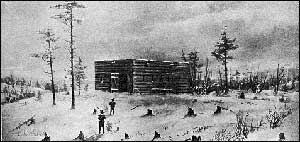
Building the Common House |
On December
29 twenty men, including Stephen and
his servants, began building the
common house. The wind and rain
constantly put a stop to their work,
but by mid-January, despite hunger
and bad weather, the 20-by-20 foot
common house was nearly complete.
The
Mayflower remained anchored in
the harbor throughout the winter.
Although the ship was cold, damp,
and unheated, it was their only
shelter until the houses could be
completed on shore. Exposure,
malnutrition, and illness began
taking their toll. Stephen had
escaped the "starving time" at
Jamestown, but he did not escape
this one. William Bradford wrote,
In two or
three months' time half of their
company died, especially in January
and February, being the depth of
winter, and wanting houses and other
comforts; being infected with the
scurvy and other diseases which this
long voyage had brought up on them,
so as there died sometimes two or
three of a day. Of 100 and odd
persons, scarce fifty remained. And
of these, in the time of most
distress, there was but six or seven
sound persons who to their great
commendations spared no pains night
or day, but with abundance of toil
and hazard to their own health,
fetched them wood, made them fires,
dressed them meat, made their beds,
washed their loathsome clothes,
clothed and unclothed them.
The women
were the hardest hit with only four
of eighteen surviving. By some
miracle, the Hopkins family and
their servants were spared. In March
some of the sick began to recover,
and those who were able began to
plant their gardens. A grateful
Bradford wrote, "the Spring now
approaching, it pleased God the
mortalitie begane to cease amongst
them, and the sick and lame
recovered apace, which put as it
were new life into them; though they
had borne their sadd affliction with
much patience & contentednes."
In early
April, the Mayflower
returned to England with a small
cargo of beaver skins and sassafras.
Not one of the pilgrims chose to
return to England. William Bradford
would later write, "May not and
ought not the children of these
fathers rightly say: Our fathers
were Englishmen which came over this
great ocean, and were ready to
perish in this wilderness; but they
cried unto the Lord, and He heard
their voice and looked on their
adversity."
Meeting the
Natives
Having
learned a great deal from his
experiences in Bermuda and
Jamestown, Stephen quickly proved
his worth to the colony. While
skilled as a hunter and fisherman,
his biggest contribution was his
ability to relate to the native
people. The Hopkins home became an
embassy where Indian chiefs were
entertained, and Stephen was asked
to participate in several important
trips to Indian settlements in the
summer of 1621.
As early as
mid-February, the settlers had
spotted Indians "skulking about the
settlement," but it wasn't until
mid-March that the groups finally
met. In this well-known encounter,
the men were going through their
military instructions, when an
Indian man walked right into the
settlement and bade them "welcome"
in their own language. He was
Samoset, a Sagamore from Monhegan
Island off the coast of Maine.
|
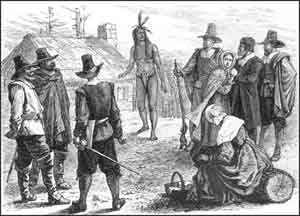
Pilgrims Meet Samoset |
Samoset was
taken to the Hopkins house where he
was given a meal of the best they
had to offer – brandy, roast duck,
biscuits and cheese, and corn
pudding. Over dinner Samoset
explained that he had learned their
language from the Englishmen who
crossed the North Atlantic each year
to fish for cod. He had heard about
the pilgrim's arrival and, for some
time, had been traveling south to
meet them.
He
explained that the Nausets, with
whom the colonists had skirmished,
harbored ill-feelings toward the
English because Captain Thomas Hunt,
an English slave-trader, had
kidnapped some of their people a few
years earlier.
Samoset
also revealed that the tribe that
had once lived here had been wiped
out by smallpox brought by the
English. The only survivor was
Squanto, one of the men who had been
captured by Hunt. Squanto had made
his way back to his homeland, and
Samoset promised to bring him on his
next visit. Samoset spent the night
with the Hopkins and left the next
day with gifts of a knife, bracelet,
and ring.
On March
22, Samoset returned with Squanto
whose adventures abroad had taught
him a great deal about the ways of
the Europeans. Being a man without a
home, family, or tribe, Squanto
settled in with the Hopkins and
became the colony's agent in their
interaction with the local tribes.
His arrival paved the way for a
visit by Woosamequin 'Yellow
Feather' also known as Massasoit the
'great chief' of the Wampanoag.
|
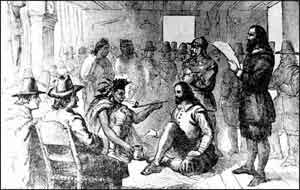
Massasoit and Gov. Carver Sign a
Treaty |
On the day
of his arrival, Massasiot was
escorted to the Hopkins house. After
eating and exchanging gifts,
Massasoit and Governor Carver began
negotiations. The Wampanoag had
powerful enemies in the
Narragansetts, and wanted the
Englishmen as allies. Being so few
in number, the colonists also needed
allies, so the two signed a peace
treaty stating that they would come
to each other's aid in the event of
attack from outsiders. It was a
momentous occasion. The peace
agreement made in the Hopkins home
that day would stand for more than
fifty years.
In the
spring the settlers began planting
their crops. Squanto showed them how
to make the most of their corn by
planting it in mounds, using fish as
fertilizer. Gov. John Carver was
hoeing in the corn fields one day,
when he suffered a stroke and died
shortly afterward. The colony then
elected William Bradford to rule
over what remained of their fragile
colony.
In July
Governor Bradford asked Stephen,
Squanto, and Edward Winslow to
locate Packanokik, the settlement of
chief Massasoit, so that they would
be able to call on him quickly in
time of need. They also wanted to
determine the size and strength of
his community and to renew the
"league of peace and friendship"
they had established with the
Wampanoags. Winslow kept a record of
their journey which would later
appear in Mourt's Relations.
On the
first day of their expedition, they
met a dozen Indians who "pestered"
them until they "grew quite weary."
The Indians led them to Nemasket
where they were entertained and fed
a kind of bread. The Indians asked
that the men shoot at a crow,
complaining about the damage the
birds were doing to their corn. One
of the men impressed them with his
marksmanship by killing the bird
from some "forescore off."
|
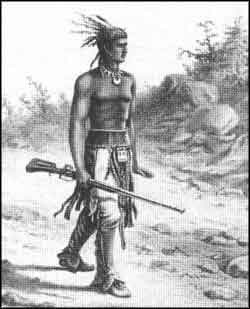
Squanto lived with the Pilgrims
for 18
months. He died of a fever in
1622. |
They
continued on their journey and by
evening came to a wide river, where
they found many Indians fishing at a
dam. They exchanged their provisions
for a meal of fresh fish, and spent
the night in the open fields as the
Indians did in the summer. The next
morning they were joined by six
"savages" who "proved friendly." The
Indians showed them where to ford
the rivers and offered to carry them
over even the smallest stream. When
either of the Englishmen looked
weary, their guides offered to carry
their provisions, and even their
clothes. They ran into others on the
trail who gave them fresh water,
roasted crabs, oysters, and other
fish.
Eventually
they reached Massasoit's village,
but he was not at home. Winslow
wrote that they "found the place to
be 40 miles from hence, the soyle
good, and the people not many, being
dead and abundantly wasted in the
late great mortalitie which fell in
all these parts aboute three years
before the coming of the English,
wherein thousands of them dyed, they
not being able to burie one another;
their sculs and bones were found
many playces lying still above
ground, where their houses and
dwellings had been; a very sad spectackle to behould."
When
Massasoit returned, the Englishmen
greeted him by firing their guns in
salute. He welcomed them into his
house, where Squanto acted as
interpreter. They gave Massasoit a
red cotton horseman's coat and
copper necklace, which he
immediately donned and modeled for
the entertainment of his tribe.
As
diplomat, Winslow suggested that
Massasoit's people should only come
to Plymouth with the consent of the
chief, since the colony was short of
food and could no longer entertain
an unlimited number of guests. They
also stated that they wanted to
repay the Nauset for the corn they
had taken from their mounds, and
asked if Massasoit would send word
to them. Winslow also asked for
trading goods, such as beaver skins,
which could be sent back to England.
Massasoit
agreed to all their requests and
gave a lengthy speech explaining the
matter to his people and naming all
thirty of his villages that were
bound by the agreement. He ended his
speech after pledging loyalty to the
English King, and telling the
pilgrims that he felt sorry for King
James whose wife, Queen Anne, had
died in 1619. He then lit tobacco
for them, and they discussed matters
in England, particularly how the
King was getting along without a
wife.
|
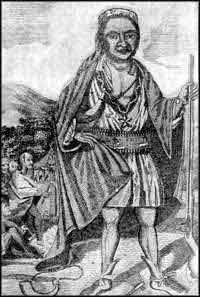
Woosamequin or Massasoit
'Great Chief' of the Wampanoag
|
When the
group retired, Stephen and Winslow
were invited to join the chief and
his wife in their bed. By custom,
the bed had to be full, so two other
tribal leaders crowded in the
remaining space. The four Wampanoags
quickly put themselves to sleep
through rhythmic chanting, but the
Pilgrims had a restless night. The
bed was full of lice and fleas, but
moving outside meant they would be
eaten alive by mosquitoes. Winslow
later complained that they were more
weary "of their lodging, than of
their journey."
The next
day the Wampanoags held games with
beaver skins as prizes. The pilgrims
didn't participate, but were asked
to demonstrate their skills as
marksmen. At noon forty men gathered
to share a meager lunch of three
large fresh water fish. The Pilgrims
spent another night with the
Wampanoags, but told the chief they
must be returning home to keep the
Sabbath.
They rose
before sunrise the next day and
departed with the six Indians who
had brought them. They shared the
last of their food with their guides
who surprised them the next morning
with a breakfast of fresh fish. They
were caught in a "great storm" on
the last day and reached Plymouth
wet and weary, but elated with
success.
Stephen and
Squanto had barely recuperated from
their trip, when they were asked to
join a search party to find young
John Billington. They soon learned
that he had been found in the woods
by the unfriendly Nausets, so they
gathered their courage and rowed the
shallop to the Nauset village.
Hearing
that the pilgrims were coming, Chief
Aspinet met the boat with "no less
than a hundred of his men," but the
colonists had nothing to fear. With
Squanto's help, they understood that
the pilgrims had come in peace and
wished to pay for the corn they had
taken. A great train of men then
carried the boy through the water to
the boat unharmed and bedecked with
beads. The colonists thanked Chief
Aspinet and the man who had found
Billington with gifts of knives.
Celebrating
the First Thanksgiving
As summer
ended, the settlers took stock of
their situation. Their crops were
successful and, if their other food
gathering efforts proved effective,
they could survive a second winter.
William Bradford wrote,
|
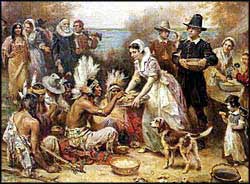
The First Thanksgiving |
They began
now to gather in ye small harvest
they had, and to fit up their
houses and dwellings against winter,
being well recovered in health &
strength, and had all things in good
plenty; for some were thus employed
in affairs abroad, others were
exercised in fishing, about cod,
& bass, & other fish, of which
they
took good store, of which every
family had their portion. All ye
somer ther was no want. And now
began to come in store of foule, as
winter approached, of which this
place did abound when they came
first (but afterward decreased by
degree). And besids water foule,
ther was great store of wild
Turkies, of which they took many,
besids venison, &c. Besids they had
aboute a peck a meale a weeke to a
person, or now since harvest, Indean
corne to yt proportion. Which made
many afterwards write so largly of
their plenty hear to their freinds
in England, which were not fained,
but true reports.
For the
first time in months, the threat of
starvation had passed, and they
could relax and enjoy the results of
their efforts with their friends and
neighbors. In a letter, Edward
Winslow describes the first
Thanksgiving at Plymouth.
Our Corne
[wheat] did prove well, & God be
praysed, we had a good increase of
Indian Corne, and our Barly
indifferent good, but our Pease not
worth the gathering, for we feared
they were too late sowne, they came
up very well, and blossomed, but the
Sunne parched them in the blossome;
our harvest being gotten in, our
Governour sent foure men on fowling,
that so we might after a more
speciall manner reioyce together,
after we had gathered the fruit of
our labors; they foure in one day
killed as much fowle, as with a
little helpe beside, served the
Company almost a weeke, at which
time amongst other Recreations, we
exercised our Armes, many of the
Indians coming amongst us, and among
the rest their greatest King
Massasoyt, with some nintie men,
whom for three dayes we entertained
and feasted, and they went out and
killed five Deere, which they
brought to the Plantation and
bestowed upon our Governour, and
upon the Captaine, and others. And
although it be not alwayes so
plentifull, as it was at this time
with us, yet by the goodneses of
God, we are so farre from want, that
we often wish you partakers of our
plenty.
Expanding
Plymouth Plantation
|

The Fortune |
In November
of 1621 the Fortune arrived
with thirty-five new settlers, but
no supplies. Robert Cushman carried
a terse letter from Thomas Weston
asking the colonists why they had
run up expenses by keeping the
Mayflower at Plymouth all
winter, and why they had not filled
her hold with more cargo for the
return trip. Then, because some of
the non-Separatists had begun to
press for individual property
rights, Cushman gave a sermon
comparing their "worldly ambition"
to the "pride of Satan."
The
colonists survived the second
winter, despite the thirty-five
extra mouths to feed, and enjoyed an
even better harvest in the fall of
1622. More settlers continued to
arrive in ships like the Anne
and Little James, so
by 1623 most of the original Leyden
congregation had made it to
Plymouth. William Bradford wrote of
the shock many of the newcomers felt
when they finally reached Plymouth,
These
passengers, when they saw their
[the original settler's] low &
poore condition a shore, were
much daunted and dismayed, and
according to their divers
humores were diversly affected;
some wished them selves in
England againe; others fell a
weeping, fancying their own
miserie in what they saw now in
others; other some pitying the
distress they saw their friends
had been long in, and still were
under; in a word, all were full
of sadness.
As Plymouth
grew, it gained many more
non-Separatist colonists who often
had difficulty adhering to the laws
established by the first-comers.
Some of the more rebellious were
even expelled from the settlement.
The non-Separatists who remained in
Plymouth disagreed with the
Separatists from time to time, but
the groups continued to work
together to make the colony prosper.
In 1624
Captain John Smith visited Plymouth
and reported, "At New Plymouth is
about 180 persons, some cattle and
goats, but many swine and poultry,
and thirty-two dwelling houses." The
houses which lined Plymouth's main
street were made in the traditional
English manner with clapboards,
wattle and daub, and oil-paper
windows.
The Hopkins
home sat across from Governor
Bradford's on the eastern corner of
Main and Leyden. It was one of the
largest houses in Plymouth to
accommodate its large family. By
1627 each house had a fenced garden
with flowers and herbs. The Hopkins
also had a barn, dairy, cow shed,
and small apple orchard. Both
Damaris and Oceanus died around
1626, but five new children, Caleb,
Deborah, Damaris (again), Ruth, and
Elizabeth, were born between 1622
and about 1630. Constance moved out
in 1628 when she married carpenter
Nicholas Snow who had sailed on the
Anne.
Stephen had
been an early proponent of the fur
trade, so expanded his house to
include a store where the Indians
could come and trade beaver skins
for English goods. In 1624 when
ships began importing wine, beer,
brandy, and gin, Stephen added a
tavern.
He also
built and owned the first wharf in
Plymouth Colony, and in 1638 built a
house at Yarmouth on Cape Cod, but
soon returned to Plymouth. He gave
the Yarmouth dwelling to Giles, who
had married Catherine Wheldon in
1639.
Between
1623 and 1638, Stephen made numerous
appearances in Plymouth Colony
records.
In the
1623 Plymouth division of land,
"Steven Hobkins" received six
acres as a passenger of the
Mayflower.
In the
1627 Plymouth division of
cattle, Stephen is listed with
his wife Elizabeth, and children
Gyles, Caleb, Deborah, and
Damaris.
In the
1633 list of Plymouth freemen
(those who were entitled to
citizenship and other special
privileges in the colony),
Stephen is near the head of the
list, included among the Council
Assistants.
On July
1, 1633 "Mr. Hopkins" was
ordered to mow where he had
mowed the year before, followed
by similar orders on March 14,
1635 and March 20, 1636.
In the
Plymouth tax list of March 25,
1634 Stephen was assessed £1 7s.
In the
list of Plymouth Colony freemen,
March 7, 1636, he appears as
"Steephen Hopkins, gent."
On
February 5, 1637 "Mr. Stephen
Hopkins requesteth a grant of
lands towards the Six Mile
Brook."
On July
17, 1637 "Stephen Hopkins of
Plymouth, gent.," sold to George
Boare of Scituate, yeoman, "all
that his messuage, houses,
tenements, outhouses lying and
being at the Broken Wharfe
towards the Eele River together
with the six shares of lands
thereunto belonging containing
six acres."
On
August 7, 1638 "liberty is
granted to Mr. Steephen Hopkins
to erect a house at Mattacheese,
and cut hay there this year to
winter his cattle, provided that
it be not to withdraw him from
the town of Plymouth."
On
November 30, 1638 "Mr. Steephen
Hopkins" sold to Josias Cooke
"all those his six acres of land
lying on the south side of the
Town Brook of Plymouth."
On June
1, 1640 "Mr. Hopkins" was
granted twelve acres of meadow.
On June
8, 1642, William Chase, in
consideration of a debt of £5
which he owed to Stephen,
mortgaged to him "his house and
lands in Yarmouth containing
eight acres of upland and six
acres more lying at the Stony
Cove."
Contending
with New Neighbors
|
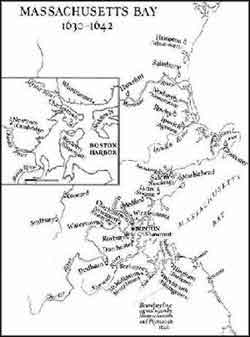
Massachusetts Bay 1630-1642 |
Eight years
after the pilgrims landed at
Plymouth, a group of colonists under
Governor John Endicott sailed into
Massachusetts Bay. They were
followed two years later by the
eleven ships of the Winthrop fleet,
which represented a far greater
investment of time, energy, and
money than had been spent on
neglected Plymouth. The pilgrims
undoubtedly looked on with some envy
as the new colonists quickly
established villages at Boston,
Salem, Cambridge, Watertown, and
Charlestown.
As the
English began to pour into New
England, tensions with the Indians
mounted, particularly after the
Indians began buying alcohol and
firearms from unscrupulous
adventurers. One of the worst was
Thomas Morton who had arrived and
taken control of a nearby plantation
at Mount Wallarton, which he
appropriately renamed "Merry Mount."
William
Bradford wrote that Morton and his
followers, mostly outcasts from
Plymouth, "set up a maypole with
much drinking, dancing, and
consorting with the Indian women . .
. after this they all fell to a
great licentiousness and from then
on led a most dissolute life." To
make matters worse, the
pleasure-seekers traded their guns
to the Indians for food rather than
interrupt their activities to go
hunting.
The Indians
soon became crack shots and, with
little provocation, began to shoot
at the English. The men at Plymouth
felt that it was a matter of
self-preservation to put an end to
this gun trade, and Stephen was
second in command of the expedition
to wipe out Merry Mount. The raiding
party caught Morton and his men off
guard, disarmed them, and sent
Morton back to England on the next
ship. But even with Merry Mount
gone, the Indians still had their
weapons and major conflict seemed
inevitable.
|
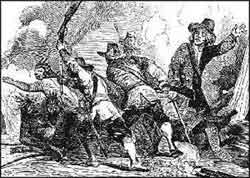
The Pequot War |
The Pequot
War of 1637, the first major
conflict between Indians and
colonists in New England, set a
brutal precedent for subsequent
Indian-European warfare. The Pequots
were accused of murdering two
Massachusetts Bay colony men, and
refused to yield up the suspected
killers. Colonial authorities
decided to retaliate, a decision
reinforced by Pequot resistance to
new Connecticut settlements. On May
26, 1637, a force of white soldiers,
along with Mohegan and Narragansett
warriors, attacked the principal
Pequot village, burned it, and
slaughtered its inhabitants. The
surviving Pequots were relentlessly
pursued, until the tribe was largely
destroyed.
Hodges
writes, "When Massachusetts Bay
called on Plymouth for help, the
older colony was reluctant. Like
most men at Plymouth, Stephen
Hopkins was opposed to the Pequot
War. It not only threatened the
physical safety of the colony, but
it could bring an end to the fur
trade which was the best hope
Plymouth had to lift its burden of
debt . . . However when the call
came for volunteers, Stephen Hopkins
and his two sons Giles and Caleb
were among the able-bodied men who
offered themselves as soldiers . . .
but before the Plymouth volunteers
could organize themselves, the
Pequot War ended."
Governing
Plymouth's Citizens
|
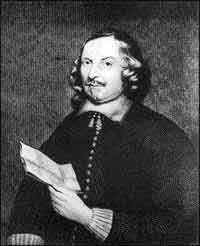
Edward Winslow |
Although
King Charles I reigned over England
and the colonies, the people of
Plymouth held that they lived under
a "government of laws, not of men."
They chose their own officials and
elected Stephen to serve as a
Council Assistant (1633-36) under
Governors Edward Winslow, Thomas
Prence, and William Bradford. In
1636 Stephen helped draw up the
"Bill of Rights" which is viewed as
one of Plymouth's chief
accomplishments.
The women
of Plymouth benefited greatly from
these new laws. While it would be
hundreds of years before women could
vote, serve on juries, or
participate in town meetings, the
women of Plymouth did gain the right
to buy, own, and sell property.
Their husbands could not sell
property without their consent, and
they were guaranteed one third of
the family estate when he died.
Women in Plymouth could also witness
a deed or probate document, and were
free to choose whom they would or
would not marry.
The court,
headed primarily by Separatists,
also enacted numerous laws to
control the behavior of its
citizenry. The more the people of
Plymouth sinned, the more the colony
made laws to control them. It is not
surprising that most of those
running afoul of the law were
non-Separatists who were fined for
everything from public drunkenness,
gambling, and idleness, to lying and
swearing.
Plymouth's
first criminal act was committed by
Stephen's indentured servants,
Edward Dotey and Edward Leister.
While Stephen was off on one of his
expeditions that first summer in
Plymouth, the two men began to
compete for the affections of his
daughter, Constance. After an open
quarrel, they went into the woods
with swords and daggers and returned
with wounds in the hand and thigh.
Dueling was
illegal, and Stephen returned home
to find his servants in handcuffs
and awaiting trial. After finding
the men guilty, Governor Bradford
consulted William Brewster's book of
English law which prescribed that
the men have their necks tied to
their feet and remain in that
agonizing position for twenty-four
hours in the town square.
|

Miles Standish |
Stephen
couldn't bear their suffering and
implored Governor Bradford and
Captain Standish to set the men
free. "Within an hour," says an
early record, "because of their
great pains, at their own and their
master's humble request, they were
released by the Governor." It had
been the first punishment meted out
by Plymouth authorities, and would
not be the last.
As a member
of the Council, Stephen helped to
enact some laws he probably came to
regret. In particular, the court
drew up strict regulations for
taverns, and held the owners
responsible for the conduct of their
customers. Plymouth court records
reveal that despite his position of
authority, Stephen had his share of
official difficulties.
In June of
1636, he was fined £5 for the
battery of John Tisdale whom he
"dangerously wounded." The court
observed that he, being an
Assistant, should have especially
been one to "observe the king's
peace."
October 2,
1637 he had two presentments before
the court, the first being "for
suffering men to drink in his house
upon the Lord's day . . . before &
after the meetings, [and for
allowing] servants & others to drink
more than for ordinary refreshing."
The second presentment was for
"suffering servants and others to
sit drinking in his house, (contrary
to the orders of this Court,) and to
play at shovel board, & such like
demeanors" for which he was fined
forty shillings.
January 2,
1638 he was again presented for
allowing "Old Palmer," James Coale,
and William Renolds to drink to
excess. According to one witness,
Palmer "lay under a table, vomiting
in a beastly manner" and Stephen was
fined seven shillings for this
incident.
June 5,
1638 he was fined £5 for "selling
wine, beer, strong waters, and
nutmegs at excessive rates" to the
"oppressing & impovishing of the
colony."
On December
3, 1639, he was again summoned
before the court for having charged
sixteen pence for a looking glass
that could be bought in the Bay
Colony for nine. On this day he was
also fined £3 for selling strong
water without a license.
The most
serious charge Stephen faced
occurred on February 4, 1639, when
he was found in contempt of court
and spent time in jail for refusing
to deal fairly with his indentured
servant, Dorothy Temple.
On showing
signs of pregnancy, Dorothy was
brought before the court where she
named Arthur Peach as the father.
Peach had recently been hanged for
the murder of an Indian boy, so
Dorothy and her child were left
without support. Dorothy was
sentenced to be whipped twice for
"uncleaness and bringing forth a
bastard" but this did nothing to
solve the problem of support. The
court then ordered that Stephen
"keepe her and her child . . .
during the said terme [of
indenture]; and if he refuse so to
doe, that then the collony provide
for her, & Mr. Hopkins to pay it."
On
receiving the order, Stephen said he
would settle the matter himself
without an order from the court. The
court found him in contempt and sent
him to jail. He spent four days
there before Mr. John Holmes, the
Messenger of the Court, agreed to
take Dorothy and her son into his
house for the sum of £3, thereby
discharging Stephen of any further
obligation for support.
After this
incident, Stephen no longer sought
public office and seems to have kept
to his own affairs. He was, by now,
the only Mayflower
non-Separatist remaining at
Plymouth, as Edward Winslow, Miles
Standish, and others had bought
property in new settlements and
moved away. William Bradford said
that Plymouth was left "like an
ancient mother grown old and
forsaken of her children."
Stephen
appears in court records one last
time on April 5, 1642 in regards to
Jonathan Hatch who was sentenced to
be whipped for "lying in the same
bed" with his sister Lydia and "was
taken as a vagrant, & for his
misdemeanors was censured to be
whipt, & sent from constable to
constable to Leiftennant Davenport
at Salem." A few days later it was
determined that Hatch would "dwell
with Mr. Stephen Hopkins, with
Hopkins to have a special care of
him."
End of the
Adventure
Stephen
found himself a widower again when
Elizabeth died around 1640. His
oldest children, Constance and
Giles, were gone by this time, but
the five younger children were
probably still at home as Caleb, the
oldest, would have been just
eighteen.
On June 6,
1644 Stephen wrote his will and
called upon his old friends William
Bradford and Miles Standish to be
his witnesses. He died sometime
before July 17th when his will was
proven. An inventory of his estate
shows that he was a rich man by
Plymouth standards.
Among his
possessions were "diverse" books,
yellow and green rugs, flannel
sheets, a white cap, a gray cloak
and breeches, a frying pan, funnels,
fireshovel and tongs, a butter
churn, two wheels, a cheese rack,
four skins, a scale and weights, and
two pails. His will, as it appears
in Plymouth records, reads,
The last
Will and Testament of Mr.
Stephen Hopkins exhibited
upon the Oathes of mr Willm
Bradford and Captaine
Miles Standish at the
generall Court holden at
Plymouth the xxth of August Anno
dm 1644 as it followeth in these
wordes vizt.
The
sixt of June 1644 I Stephen
Hopkins of Plymouth in New
England being weake yet in good
and prfect memory blessed be God
yet considering the fraile
estate of all men I do ordaine
and make this to be my last will
and testament in manner and
forme following and first I do
committ my body to the earth
from whence it was taken, and my
soule to the Lord who gave it,
my body to be buryed as neare as
convenyently may be to my wyfe
Deceased And first my will is
that out of my whole estate my
funerall expences be discharged
secondly that out of the
remayneing part of my said
estate that all my lawfull Debts
be payd thirdly I do bequeath by
this my will to my sonn Giles
Hopkins my great Bull wch is
now in the hands of Mris Warren.
Also I do give to Stephen
Hopkins my sonn Giles his sonne
twenty shillings in Mris Warrens
hands for the hire of the said
Bull Also I give and bequeath to
my daughter Constanc Snow
the wyfe of Nicholas Snow
my mare also I give unto my
daughter Deborah Hopkins
the brodhorned black cowe and
her calf and half the Cowe
called Motley
Also I
doe give and bequeath unto my
daughter Damaris Hopkins
the Cowe called Damaris heiffer
and the white faced calf and
half the cowe called Mottley
Also I give to my daughter Ruth
the Cowe called Red Cole and her
calfe and a Bull at Yarmouth wch
is in the keepeing of Giles
Hopkins wch is an yeare and
advantage old and half the curld
Cowe Also I give and bequeath to
my daughter Elizabeth the
Cowe called Smykins and her calf
and the other half of the Curld
Cowe wth Ruth and an
yearelinge heiffer wth out a
tayle in the keeping of Gyles
Hopkins at Yarmouth Also I do
give and bequeath unto my foure
daughters that is to say
Deborah Hopkins Damaris Hopkins
Ruth Hopkins and
Elizabeth Hopkins all the
mooveable goods the wch do
belong to my house as linnen
wollen beds bedcloathes pott
kettles pewter or whatsoevr are
moveable belonging to my said
house of what kynd soever and
not named by their prticular
names all wch said mooveables to
be equally devided amongst my
said daughters foure silver
spoones that is to say to eich
of them one, And in case any of
my said daughters should be
taken away by death before they
be marryed that then the part of
their division to be equally
devided amongst the Survivors. I
do also by this my will make
Caleb Hopkins my sonn and
heire apparent giveing and
bequeathing unto my said sonn
aforesaid all my Right title and
interrest to my house and lands
at Plymouth wth all the Right
title and interrest wch doth
might or of Right doth or may
hereafter belong unto mee, as
also I give unto my saide heire
all such land wch of Right is
Rightly due unto me and not at
prsent in my reall possession
wch belongs unto me by right of
my first comeing into this land
or by any other due Right, as by
such freedome or otherwise
giveing unto my said heire my
full & whole and entire Right in
all divisions allottments
appoyntments or distributions
whatsoever to all or any pt of
the said lande at any tyme or
tymes so to be disposed Also I
do give moreover unto my
foresaid heire one paire or
yooke of oxen and the hyer of
them wch are in the hands of
Richard Church as may appeare by
bill under his hand Also I do
give unto my said heire Caleb
Hopkins all my debts wch are now
oweing unto me, or at the day of
my death may be oweing unto mee
either by booke bill or bills or
any other way rightfully due
unto mee ffurthermore my will is
that my daughters aforesaid
shall have free recourse to my
house in Plymouth upon any
occation there to abide and
remayne for such tyme as any of
them shall thinke meete and
convenyent & they single persons
And for the faythfull prformance
of this my will I do make and
ordayne my aforesaid sonn and
heire Caleb Hopkins my
true and lawfull Executor
ffurther I do by this my will
appoynt and make my said sonn
and Captaine Miles Standish
joyntly supervisors of this my
will according to the true
meaneing of the same that is to
say that my Executor &
supervisor shall make the
severall divisions parts or
porcons legacies or whatsoever
doth appertaine to the
fullfilling of this my will It
is also my will that my Executr
& Supervisor shall advise devise
and dispose by the best wayes &
meanes they cann for the
disposeing in marriage or other
wise for the best advancnt of
the estate of the forenamed
Deborah Damaris Ruth and
Elizabeth Hopkins.
Thus
trusting in the Lord my will
shalbe truly prformed according
to the true meaneing of the same
I committ the whole Disposeing
hereof to the Lord that hee may
direct you herein
June 6th 1644
Witnesses hereof By me Steven
Hopkins
Myles Standish
William Bradford
|
Plymouth's Burial Hill Site of
the Old Fort and
First Pilgrim Graveyard |
In 1650
William Bradford wrote, "Mr. Hopkins
& his wife are now both dead, but
they lived about 20 years in this
place & had one son and four
daughters born here. Their son
[Caleb] became a seaman and dyed at
Barbadoes, one daughter died here &
two are married, one of them hath
three children and one is yet to
marry. So their increase which still
survive are 5, but his son Giles is
married & has 4 children. His
daughter Constanta is also married &
hath 12 children all of them living
& one married. One of these children
was Mary Snow, who married Thomas
Paine. Stephen settled in the part
of Eastham now included in the town
of Orleans, on the place at the head
of the Cove, called by the Indians
"Kesscayoganseet" and later owned
and occupied by James Percival."
During
Stephen Hopkin's lifetime the
settlements of Jamestown and
Plymouth were more reviled than
admired. Jamestown was a disaster,
and Plymouth was damned as a hotbed
of radicals who would destroy Church
and State. But these settlements,
which began as mere commercial
enterprises, contributed to the
United State's most treasured
consitutional ideals.
The
tradition of representative
government began in Jamestown and,
echoing Stephen's declaration in
Bermuda that he was "freed from
the government of any man,"
Plymouth Colony created a government
"of laws, not of men." It drew up a
Bill of Rights, gave women
property and dower rights, and
honored a peace treaty with the
Wampanoag for a record fifty years.
If Stephen Hopkins had done nothing
more than to help found 'Plimoth
Plantation,' he would deserve a
place in history.
Bibliography
Bradford,
William. Of Plymouth Plantation,
1620-1647, Samuel Eliot
Morison, ed. New York, 1952.
De Costa,
B.F. "Stephen Hopkins of the
Mayflower." The New England
Historical and Genealogical Register.
133: 300-305. July, 1879.Hayward,
Kendall Payne.
"The
Adventure of Stephen Hopkins."
The Mayflower Quarterly 51(1):
5-9. February, 1985.
Heath,
Dwight B., ed., A Journal of the
Pilgrims at Plymouth: Mourt's
Relation, New York, 1963 (first
published in London, 1621).
Hodges,
Margaret. Hopkins of the
Mayflower. New York: Farrar,
Straus & Giroux, 1972.
Johnson,
Caleb."The True Origin of Stephen
Hopkins of the Mayflower," The
American Genealogist July 1998,
Vol. 73, No. 3.
Jourdain,
Silvester. "A Discovery of the
Bermudas, Otherwise Called the Isle
of Devils." in Wright, Louis B., ed.
A Voyage to Virginia in 1609.
Charlottesville: University of
Virginia, 1964.
King,
Jonathan. The Mayflower Miracle: The
Pilgrim's Own Story of the Founding
of America, London, David and
Charles, 1987.
Kolb,
Avery. "The Tempest." American
Heritage. 34(3) : 26-35.
April/May, 1983.
Maitland,
Charmian. "Stephen Hopkins in
England." The Mayflower
Quarterly 51(1): 7-9. February,
1985.
Mayflower Families (Vol. 6): Stephen
Hopkins for Five Generations,
General Society of Mayflower
Descendants, 1992.
Shurtleff,
Nathaniel B and David Pulsifer, eds.
Records of the Colony of New
Plymouth in New England,
Boston, 1855-1861.
Stachey,
William. "A True Repository of the
Wreck and Redemption of Sir Thomas
Gates, Knight." in Wright, Louis B.,
ed. A Voyage to Virginia in
1609. Charlottesville:
University of Virginia, 1964.
Stratton,
Eugene Aubrey. Plymouth Colony,
Its History and Its People,
1620-1691, Salt Lake City, 1984
Young,
Alexander, ed. Chronicles of the
Pilgrim Fathers of the Colony of
Plymouth, Boston 1844; rpt.
Baltimore, 1974.